The products defining my vision.
Years of working on and growing other people's businesses and products has driven a deepening desire to commit to the creation of my own.
Now, three shipped products and counting, I finally have the space to work on and grow my own ideas with no limitations. I have room to not just control the strategic approach, but to execute full creative and logistical control inside and outside of each business.
"Build something 100 people love, not something 1 million people kind of like." – Brian Chesky
I spent a decade developing strategy for brands I didn't own. The discipline is the same — the difference is that after the deck, someone else executes. These three products exist because I wanted to close that loop. If the strategy is right, I want to prove it by shipping it.
None of these are vibe-coded. They're built with AI tools and a working understanding of the developer-team process from ten years of directing engineers on campaign builds. Vol has a technical co-founder (Zach Converse); ParaBuyer and Straji I built solo with AI assistance and a developer collaborator. The point isn't that AI tools make engineering trivial. The point is that experience directing technical work translates directly into operating AI tools as if they were a small team.
The three products below are documented end-to-end. You'll see the market hypothesis, the brand system, the technical architecture, the traction, and the honest state of each.

Building a modern home for a sport without one.

CH.1 — MARKET + THESIS
The market
In paragliding, community is not some optional layer on top of the sport. It is part of the sport itself. And yet, for a sport so deeply dependent on connection, we lack meaningful infrastructure that reflects that reality.
Right now, the appetite to share and engage is scattered across Facebook groups, Instagram posts, WhatsApp threads, Telegram chats, club email lists, forums, and disconnected local circles. Those tools do useful work, but none of them really serve as a home for the sport as a whole. They fragment discussion, isolate communities from each other, and make it harder for pilots to participate beyond the small pocket they already happen to be in.
Most of the dominant platforms for paragliding were built around a specific kind of pilot. Competitive, performance oriented, data driven, and focused primarily on distance, rankings, and measurable achievement. That is a real and important part of the sport. But it is not most of the sport. A huge portion of the sport looks at what exists today and does not see themselves in it. The result? An experience gap where the majority of freeflight pilots feel that they have no place leading to a lower retention of pilots, less engaged communities, and most harmfully: a diminished passion for flying.
Free flight is a small niche. No mainstream company is coming to build for us in a way that truly fits how pilots fly and relate to one another. If we want tools and spaces to build ourselves a stronger, more connected global community, one that reflects the real culture of free flight, we would have to build it ourselves.
So we did. We created VOL to fill that void. To ensure that every pilot regardless of skill level, motivation, or ambition can maintain the same pride and excitement of their first flights in every flight forever after.
"A huge portion of the sport looks at what exists today and does not see themselves in it."Flight-native data ingestion
- IGC file upload with server-side parsing and stats derivation
- Public flight upload API, 14 documented response codes
- Source allowlist: FlySkyHy · XContest · Vol
Native across every major platform
- iOS (iPhone native, Apple Silicon macOS, visionOS 1.0+)
- Android (API 24+)
- Web (full feature parity)
Social + community
- Rich flight posts with 3D track visualization
- Chat with private groups, public group lookup, subscribable threads
- Profiles with accomplishment + activity stats
- Achievement tracking (gamified progression)
- Notifications feed
Privacy-forward
- No third-party data sharing
- Opt-in-only analytics
- User data deletion on request
- Encrypted data in transit
Ch. 3 — The community strategy
The platform's growth doesn't come from acquisition spend. It comes from being the place pilots actually want to spend time. We organize the strategy around two parallel objectives: what the company commits to building, and what the community gets in return for showing up. The first earns trust by setting a bar for the sport's infrastructure. The second is the daily reason a pilot opens the app — the meeting, mentoring, learning, and recognition loops that make the next flight feel more connected than the last.
To enable the freeflight community into being the best connected global community in the world.
A platform that energizes every pilot to fly more through best-in-class connection, fulfillment, and competition.
Every site should feel like your home site.
Every flight should bring the same pride as your first flight.
Every task should be fun, engaging, and accessible.
To create a global network of pilots whose experiences as pilots are enhanced by the engagements they get through Vol.
To create an experience so enabling that users establish new communities on, or shift their own communities to, Vol.
CH. 4 — INTEGRATIONS + PARTNERSHIPS

Our user acquisition strategy isn't to start from scratch. We think it comes from being woven into the endemics that pilots already trust: connecting to the flying hardware all pilots use, custom programing and features for clubs across the world, the races that define the sport. We win when we're seen as a community player for our commitment to being interconnected.
Integrations
FlySkyHy — most downloaded paragliding flight instrument on iOS. Direct IGC upload contract agreed; staging access provisioned.
"The interface spec looks professional, I am sure that can be supported."
AIR³ — a leading flight-instrument manufacturer. Integration in progress to bring native flight data into Vol — another proof point of weaving into the sport's critical infrastructure to reduce barriers to connection.
XContest — dominant paragliding competition platform globally. Integration pitch delivered Jan 2026; three partnership options on the table including full-product merge. Included in the Vol source allowlist.
Partnerships
Red Bull X-Alps 2025 — invited as content creators assisting Red Bull's official media team on race coverage. Places Vol alongside the sport's most recognizable brand at its marquee event.
USHPA — official supporter of the United States Hang Gliding & Paragliding Association, the country's top governing body for free flight. Aligns Vol with the institution that ratifies pilot ratings, sanctions competitions, and represents the sport at the national level.
XC Magazine — editorial contributor to free flight's most-read publication, writing category thought leadership that frames where the sport is heading and invites collaboration across the community.

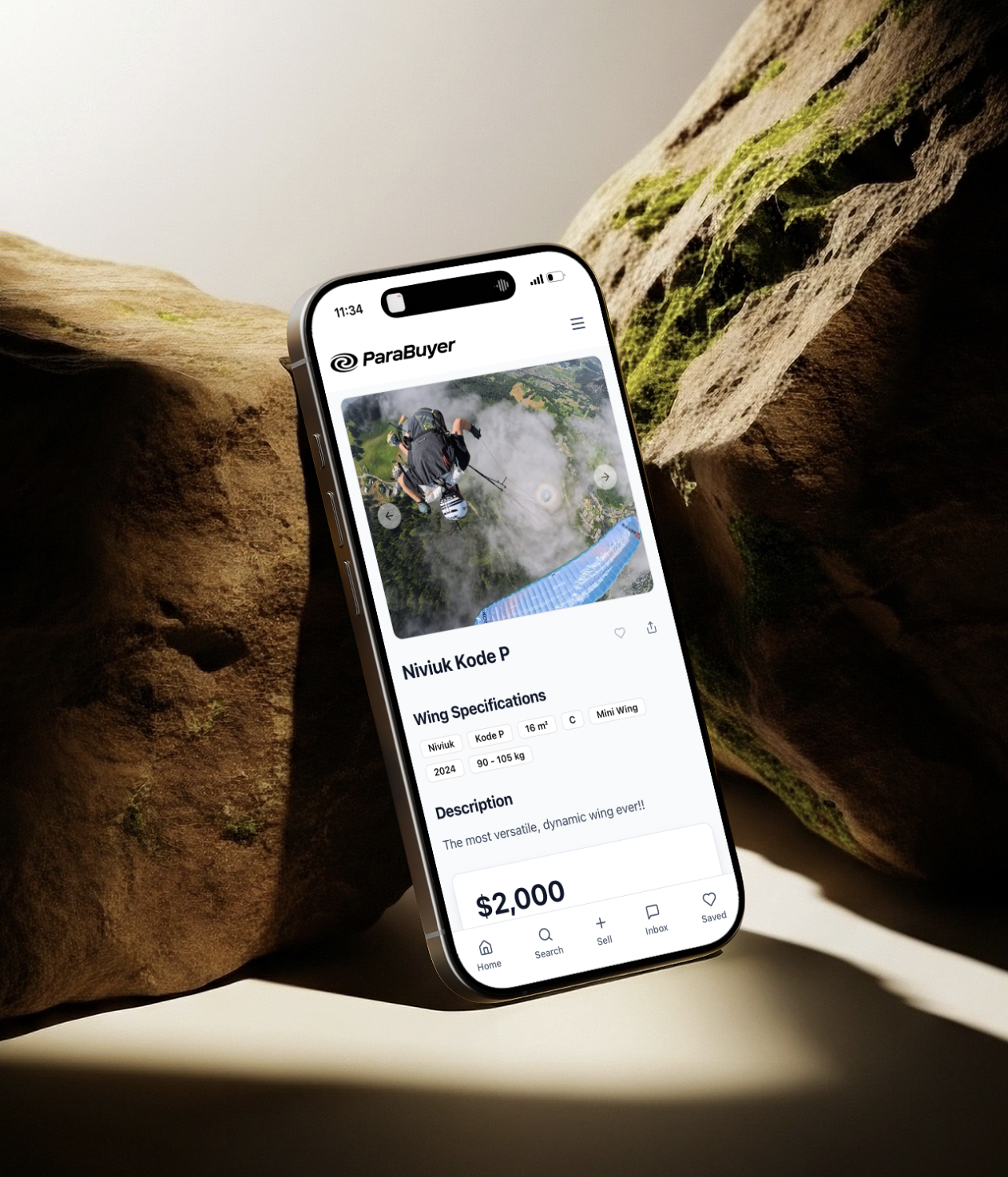
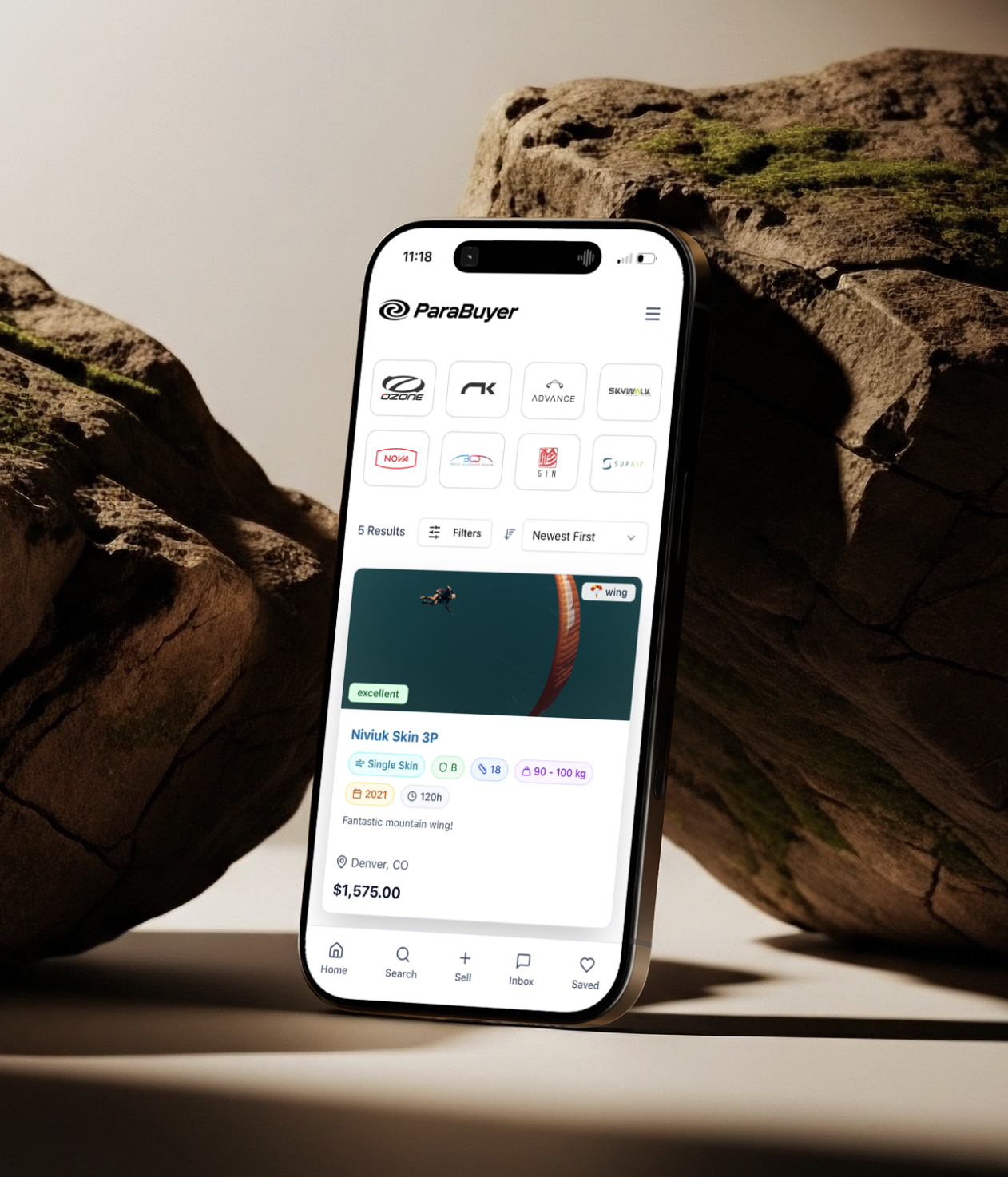
The marketplace the category always needed.

CH.1 — MARKET + THESIS
THE HYPOTHESIS
With the outdoor equipment we need to participate in the sports we’re passionate about, we’re able to manifest the truest versions of ourselves.
Used gear marketplaces in that sense can be launch pads. They connect people with the gear they need to chase their dreams in the outdoors. Not only do they enable millions of outdoor enthusiasts to get outside, but for many, used equipment is the only option for affording an active outdoor lifestyle. There's a fundamentally interesting brand story that can be told at the intersection of accessibility and enablement.
The current platforms to buy used gear are BORING. It is an outstandingly missed opportunity. They could be powerful, community enabling, high-profiting, lifestyle brands. Paragliding being an underserved niche presented the opportunity to test the hypothesis. ParaBuyer is the dedicated effort to prove that with a traditional consumer-brand approach, we can create platform and brand value that’s far greater than just the gear we help find new homes for.
"Used gear increases accessibility. Accessibility is the foundation of recreation."Ch. 2 — The brand system
From the start, ParaBuyer has been built as a lifestyle brand — not a listing site. The category's incumbents treat resale as a utility: post the photo, set the price, get the email. That framing flattens the thing the sport actually trades on, which is identity. Buying a wing means something. Selling one means something. The brand has to represent an understanding of that dynamic and embrace it.
ParaBuyer is built endemic to free-flight: a wordmark and logo with their own construction logic, a sky-derived palette, and a visual world drawn from thermals, spirals, raptors, and the technical literature of the sport. The marketplace mechanics are world-class underneath — escrow holdings, automated logistics, dispute handling — but the surface the pilot meets is a brand they want to belong to.

Most marketplaces treat their users as inventory; ParaBuyer treats them as the brand. Reframing a peer-to-peer transaction as a generosity loop — the pilot selling a wing is enabling someone else fly, the pilot buying it is honoring whoever flew it before — is what makes the community mission ("activate their freeflight dreams") do real work rather than sit on a slide.
| Layer | Statement |
|---|---|
| Company Mission | To help pilots chase their dreams by connecting them with the exact equipment they need to make it happen. |
| Company Vision | Freeflight's favorite digital shop to reliably and rapidly sell, find, and buy any piece of equipment. |
| Community Mission | To create a global network of pilots who use ParaBuyer to activate their freeflight dreams, and to help others activate theirs. |
| Community Value | To create a marketplace experience so premium that pilots prefer buying used from ParaBuyer than new from anyone. |
| Proof |
|
Ch. 3 — The product
Money moves safely
- Stripe Connect for seller payouts
- Stripe Tax by jurisdiction + rate, audit trail IDs
- Stripe escrow infrastructure to protect users
- 7-day buyer approval window with auto-approve
- Seller strike system (warning / strike / suspension)
- Dispute reconciliation · original-fee preservation
Gear actually arrives
- EasyPost · carrier rate shopping, auto-labels
- Full USPS/FedEx tracking telemetry
- Pickup + shipping delivery modes
- Buyer rejection flow with reason capture
Right gear finds right pilot
- SavedSearch · email/push frequency preferences
- Watchlist + real-time match queues
- Message offer / counter_offer state machine
- Klaviyo lifecycle email
- 2FA · encrypted secret + backup codes
- GearReview + SpecChangeProposal community layers
Intelligence across the stack
- Listing assistant · spec extraction from photos + text
- Pricing intelligence · comp-set + condition-aware suggestions
- Buyer-match agent on SavedSearch + watchlist
- Dispute triage assist · evidence summarization
- Moderation · listing & message safety classifiers
- SEO content generation · category + brand-page coverage
Ch. 4 — Operational GTM phasing
A peer-to-peer marketplace is not one product — it's payments, tax, escrow, shipping, dispute reconciliation, jurisdictional compliance, CRM, SEO, and brand running in parallel, each with its own dependencies and failure modes. Shipping that as a sole founder requires the work to be sequenced, not just listed. The phasing below is the operational structure I've used to keep the build, the financial architecture, the legal posture, and the brand moving in lockstep — so that by the time real users transact, every piece of the stack has been pressure-tested in order.

The methodology I used on Fortune 500 brands, now software.
CH.1 — THE THESIS
A decade of senior brand-strategy work at agencies produces a method. You stop being surprised by briefs. The same structures repeat: a fundamentals deck, an audience segmentation, a 4 C's analysis, a positioning, a funnel strategy, a media plan, a pitch, a GTM. The specifics of the output change per engagement. The structures don't.
Straji turns that method into a product. Seven categories, twenty-three artifact types, each generated from a project-specific intake that asks the same questions a good strategy partner would ask in the first kickoff meeting. The output isn't a template; it's a fresh strategic artifact per project, grounded in the brand-specific intake, with AI-generated rationale explaining why each framework was chosen.
"Every other product in this portfolio was strategized in Straji. Straji is where the thinking behind the thinking lives."Ch. 2 — The IA is the methodology
These are not generic SaaS categories. The 4 C's Analysis is a specific planner framework. "Pitch Essentials" is the canonical VC pitch structure. External Briefs activate real hand-offs to media, creative, social, CRM, PR partners — the actual seams an agency stitches. Every artifact carries AI-generated rationale explaining why that framework was chosen for this particular brand intake. Version chains preserve per-section edit history.
Intake Questionnaire
Brand Foundations
Audience
Communications Planning
Media Planning
Research
Executive Materials
External Briefs
The two other products in this portfolio — Vol and ParaBuyer — exist as Straji projects. Their Fundamentals, Target Audience, 4 C's Analysis, and Positioning artifacts were generated through Straji. ParaBuyer's Funnel Strategy was iterated to v5 inside the tool before being translated into the public product surfaces.
The claim that the methodology is productized isn't rhetorical. It's auditable in the data.
Ch. 4 — Where Straji is headed
Straji today is a text-based generative tool: intake in, strategic artifacts out. The next phase moves it from a document factory into a reactive environment — one that responds to how comprehensively the user is engaging with the platform, surfaces the right framework at the right moment, and rewards depth of use with progressively richer output. The visualizations below are early studies of that interaction model: each frame represents a different shape the same underlying methodology can take as the user pushes further into a project.